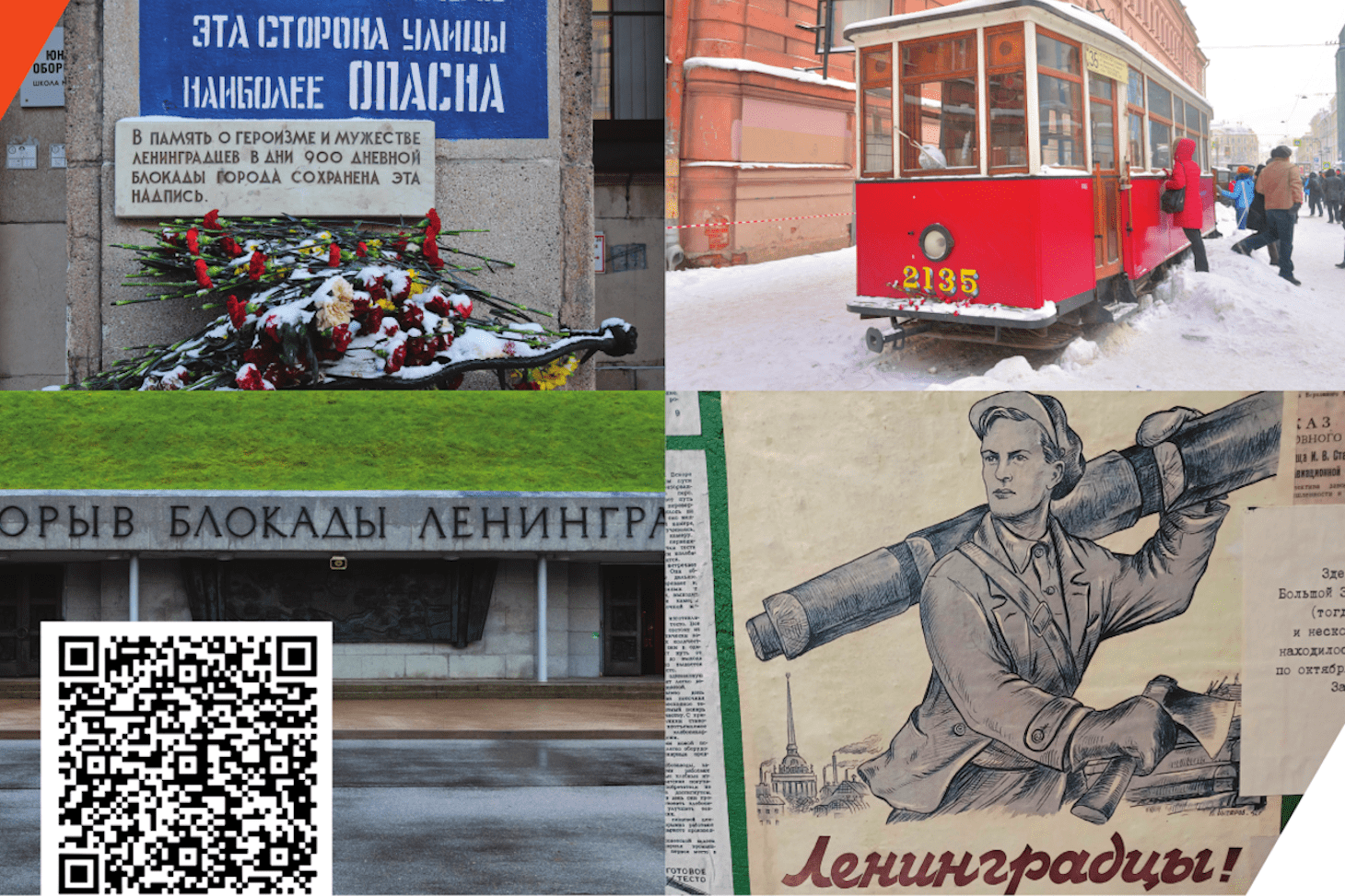
Questioning the memory of the Siege of Leningrad

Search
A number of events took place in conjunction with the conference “The Politicization of Memory: The Siege of Leningrad in Discourse, Practice, and Research,” organized by ILCEA4 and the Max Weber Network Eastern Europe.

Exhibition

The works of students in the Master 2 LLCER program, Russian Studies track, invite you to an exhibition on the Siege of Leningrad. They highlight the key stages of this a tragic historical event, and trace the living conditions of the residents of the besieged city. They also revisit the memory of this painful event from an aesthetic perspective, drawing on the poetic work of Polina Barskova. This project was created for a history class, based on scientific and literary sources.

Conference: “The Politicization of Memory: The Siege of Leningrad in Discourse, Practice, and Research”

A cultural program was organized in conjunction with this conference: screenings of documentary films on the Siege of Leningrad by Jessica Gorter and Sergei Loznitsa; a presentation of Sarah Gruszka’s book, *The Siege of Leningrad* (Tallandier, 2024); and a poetry reading by Polina Barskova.

The educational component of the project consists of four courses (Cultural Studies, Translation from Russian to French [M1 LLCER Russian Studies], History [M2 LLCER Russian Studies], Literature [L1 LLCER Russian]). The goal is to develop students’ language skills (written and oral production, oral interaction, translation), to develop their intercultural mediation skills, and to develop their expertise in academic writing and oral presentation, with a view to introducing them to research.

This project thus aligns with several priority areas of the SoCLE Department:
  • It is aimed at undergraduate and graduate students, as well as those in the LLCER and LEA programs, and some of its initiatives (related to the BUDL) are intended for a broad audience (interdisciplinary);
  • it puts students in an active role and highlights their work;
  • It allows students to explore the world of research and takes place, in part, outside the university;
  • Through the students’ work and projects, it promotes Russian studies in Grenoble, including to an international audience (the vast majority of conference participants will be specialists in the field, some of whom will be coming from Austria, Germany, or the United States).
Updated on May 22, 2026