- UFR SoCLE
- Training
- Projects
- Library
- International
- News

 Societies, Cultures and Modern Languages
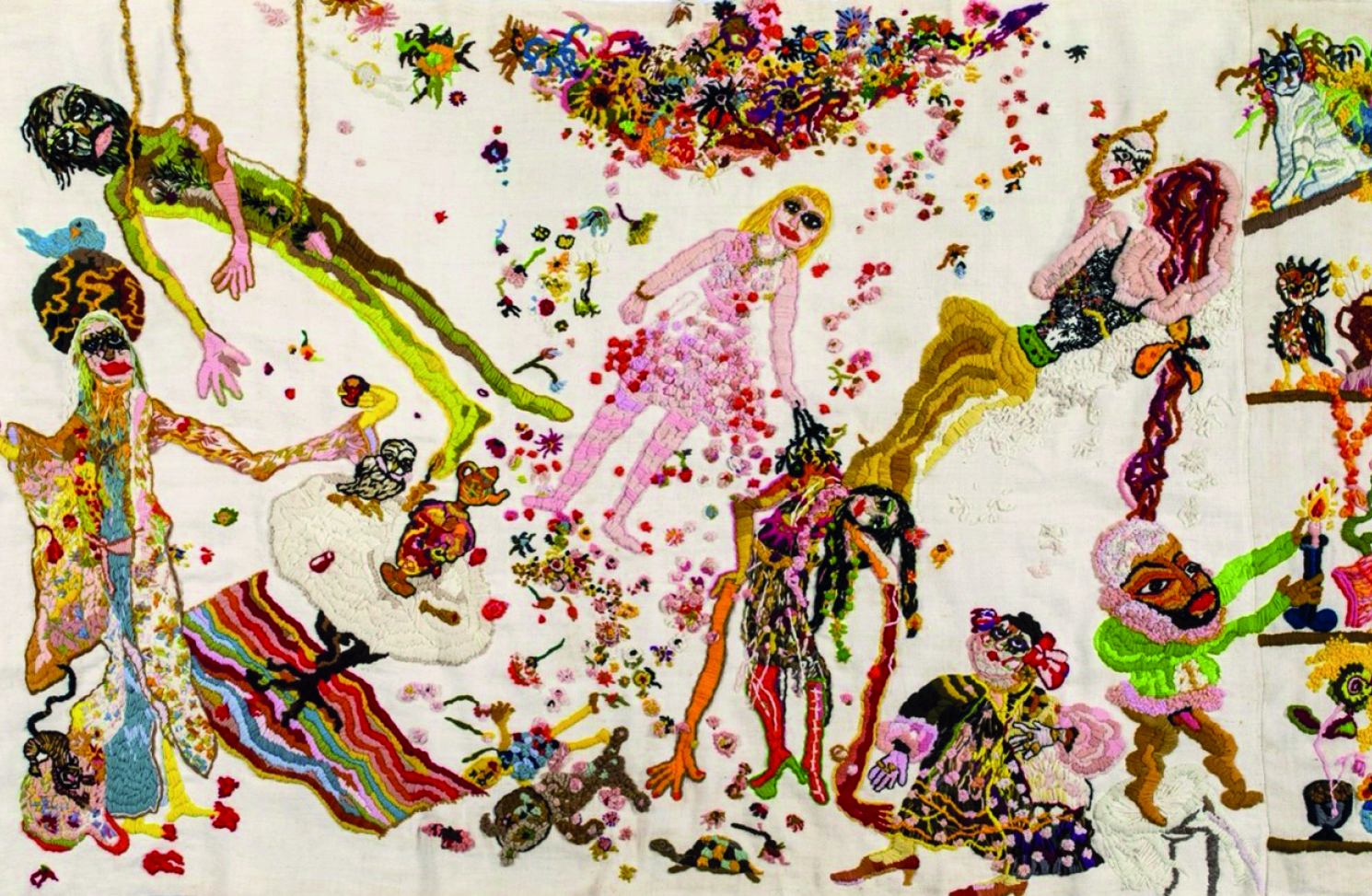
For a long time, embroidery has been associated with the domestic sphere and with women. Classified as “folk art” or “crafts,” it has long been viewed as decorative and utilitarian, which has effectively relegated it to the margins of Art.
However, in today’s world, marked by multiple crises—political, social, economic, ecological, and health-related—its status is changing, thanks to committed artists and artisans who are taking part in efforts to raise awareness, challenge the status quo, and rebuild identity. Embroidery is becoming a powerful medium for transmitting memories, resistance, and the affirmation of marginalized subjectivities (Chapelain, 2025; LaDuke, 1983). Whether associated with traditional materials (shirts, headdresses, aprons, napkins, handkerchiefs, gloves, etc.) or presented as a contemporary artistic creation, the act of embroidery allows for the transcription, through an alternative form of writing, of narratives of war, exile, mourning, struggle, and resilience. The case of Ukrainian vyshyvanka (embroidery) powerfully demonstrates how it becomes a political tool and a symbolic gesture of identity survival (Gorski, 2021; Greet, 2024). It can also become a form of discreet or explicit activism—feminist or ecological—challenging social norms, power dynamics, and dominant narratives (Parker, 1984; Bernard, 2018).
This symposium aims to explore embroidery as an artistic, social, and political practice across a variety of historical and contemporary contexts. More specifically, the presentations will focus on two main themes. The first will examine how the return to traditional forms of embroidery constitutes an act of resilience, transmission, and resistance in regions affected by conflicts or political, economic, and social crises. The second explores the ways in which contemporary art reappropriates embroidery as a militant, critical, and subversive practice. It aims to bring together the perspectives of researchers, artists, art historians, anthropologists, sociologists, and international practitioners on the critical uses of embroidery in crisis situations.
On the sidelines of the event
— 5:00 PM – 5:30 PM · Musical performance
The performance brings together various musical traditions from around the world, each expressed through a distinct piece. Traditional Ukrainian singing blends with the deep tones of the oud and double bass, carrying melodies across cultures. Although these traditions may seem distant, their convergence reveals an underlying interdependence, honoring their common roots while loosening the bonds of inherited traditions.
Musicians: Alex Reznik, oud; Simon Paul, bass; Anna Archypchuk, piano.
— 5:00 PM – 7:00 PM · Opening reception for the exhibition “Devant les œuvres et les broderies”
The program includes a guided tour of the contemporary art exhibition accompanying the study day, as well as a discussion with artists Josée Brouillard (Canada), Awena Cozannet (France), Alexey Reznik (Canada), Helene Jospé (France), Annick Piccio (France), Tatiana Bailly (France), and Tatiana Fougal (honorary attaché at the Musée de l’Homme), who will present her collection of ryshnyky.
This exhibition will be held in the MaCI exhibition space from May 6 to 29, 2026. Another guided tour of the exhibition will be offered on May 27 at 12:30 p.m. (free admission).
The aim of this exhibition is to extend the dialogue among the speakers from the Study Day through works that employ traditional or intuitive embroidery techniques as a form of socially engaged expression. It will allow for continued reflection over a longer period and reach a wider audience. The exhibition space on the second floor of the MaCI will feature works by artists from the Ukrainian diaspora, as well as Polish, Canadian, and French artists, who are reinventing the act of embroidery within alternative narratives of the history of conflict and resistance. The exhibition will also highlight several pieces of traditional embroidery, such as20th-century Ukrainian rushnyks and gloves embroidered by craftswomen from Grenoble.
— May 27 · 2:00 PM – 3:30 PM · “Cross-Stitch Embroidery” Masterclass by Tamara Dovhun
Free with registration.
The symposium and exhibition are a collaboration between the Litt&Arts and ILCEA4 laboratories, the GATES project, and MaCI.
9 a.m. – 7 p.m.