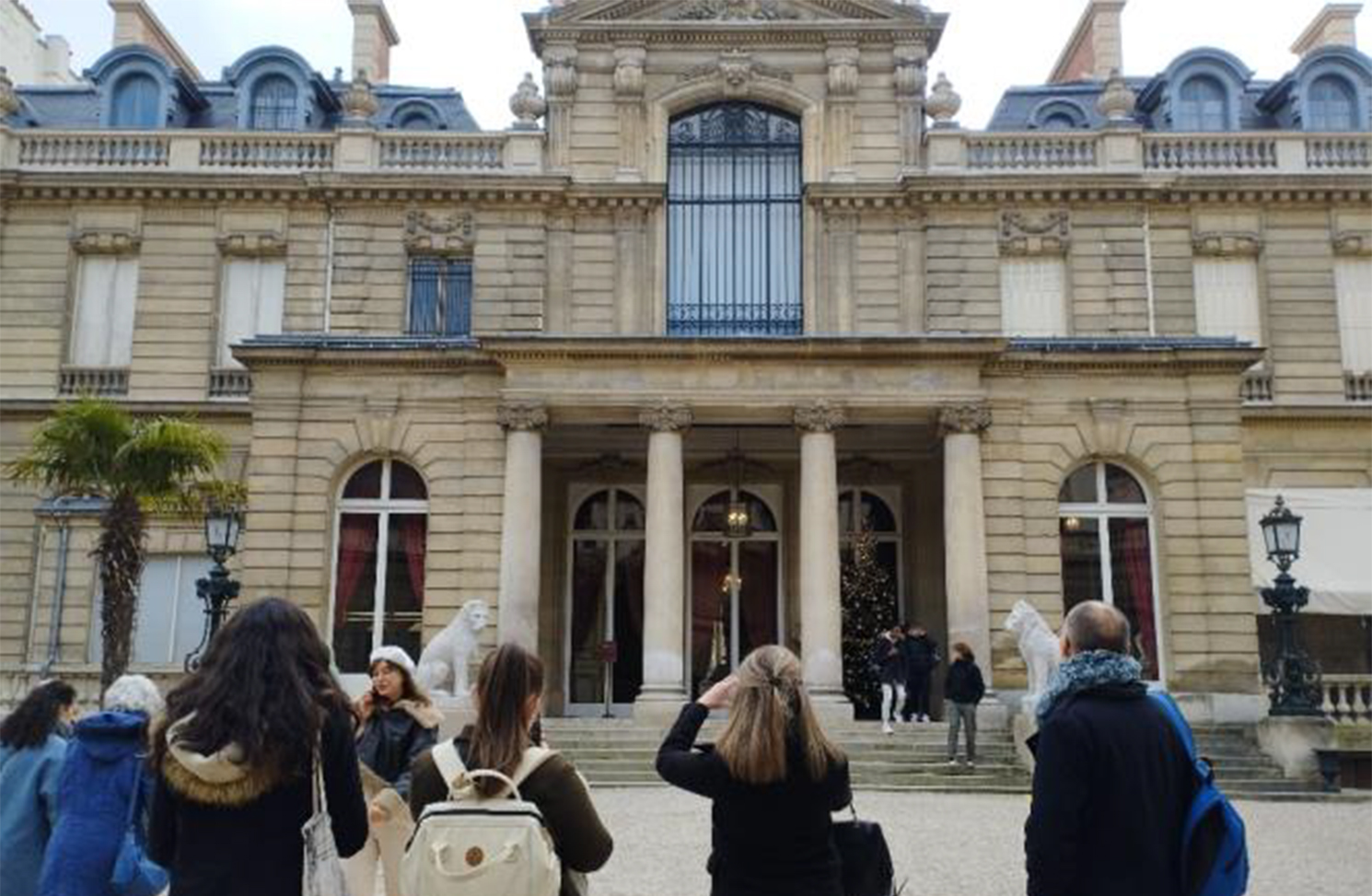
Master 2 LLCER students in English-speaking studies report on their artistic expedition to Paris, under the tutelage of Sébastien Scarpa, as part of their course on the representation of emptiness and lacunar spaces in art.
"On December 12, 2022, thanks to the support ofUniversité Grenoble Alpes, we were lucky enough to go to Paris to discover two temporary exhibitions: one dedicated to Henry Füssli and the other to Sam Szafran. This was part of our courses in Master LLCER (English Studies), on the representation of emptiness and lacunar spaces in art, with Mr. Sébastien Scarpa.
It was a unique opportunity, all the more so as Füssli's works are rarely exhibited in France. It was particularly enriching for us to see with our own eyes works that we had been studying in class for several years already.
The students taking part in this educational trip were Laury Barbier, Aude Leleu, Lauren Fabrizio and Léo Rolland.
Musée Jacquemart-André, works by Henry Füssli
The first part of the day was devoted to an exhibition of works byHenry Füssli atMusée Jacquemart-André. Füssli's wide range of themes makes his work all the more fascinating. Füssli was particularly interested in theater, and drew his inspiration from famous playwrights such as Shakespeare and Marlowe.
However, the sources of his inspiration are diverse, as he has also often drawn on ancient myths and Greek and Roman mythology to create his paintings. Visitors can appreciate (or be frustrated by) his frequent use of cut-outs and ambiguous gazes. We also notice a penchant for the fantastic and the supernatural, through the depiction of monstrous creatures and witches, for example. The artist's skilful use of areas of darkness draws the viewer's gaze and appeals to the imagination, for what they signify is perhaps inexpressible and untold...
Musée de l'Orangerie, works by Sam Szafran
The second visit was to the Musée de l'Orangerie, where the exhibition focused mainly on Sam Szafran (1934-2019). Some of his works were exhibited following the death of one of his promoters (Claude Bernard) in November 2022. This Polish-born artist combined watercolor and pastel in a prolific and impressive body of work. Observing his works, we noticed the extent to which the artist plays with perspective and distortions of vision and space. His subjects are quite singular and surprising: workshops, staircases, foliage... Through repeated explorations of his everyday environments, Szafran questions what it means to "inhabit space".
He is considered a master of pastel and watercolor; a pattern of repeated parallel lines in many of his works reveals his desire to represent his working tools - his pastels - in the paintings themselves: a kind of meta-gesture to address the artist's position as "creator of worlds".
Szafran's works, which stimulate the viewer's capacity for interpretation, fit in well with the continuity and main theme of our art courses. But our shared unfamiliarity with Szafran's work on this outing enabled us to analyze his pastels with fresh eyes, and to find significant resonances with Füssli's chiaroscuro. The particular use of emptiness (or, ironically, the absence of emptiness) is a striking example. Füssli often seems to depict "absence" as both threatening and symbolically stimulating: a void for a projection of the unconscious. Szafran, on the other hand, often compulsively fills his canvas with maximalist details or multiplied perspectives, as if obsessively seeking to fill the void. Yet this only makes the "absence" in his work more striking.
Conclusion
We strongly encourage students who are able to do so to visit such exhibitions, ephemeral or otherwise. They give us a different perspective, revealing details that we wouldn't necessarily perceive from behind a screen. Last but not least, they allow a greater degree of closeness to the work and its creator, not to mention another way of opening up to culture and guaranteeing fond memories. An experience like this is not to be missed by any student!
Article written by Laury Barbier, Aude Leleu, Lauren Fabrizio and Léo Rolland.
Share linkCopyCopyClose modal windowShare this page URLI recommend this page:Available at this address :The page will then be accessible from your "My favorites" menu.Stop videoPlay videoMute soundPlay soundChat: Got a question?Chatbot Robo FabricaMatomo visitor statisticsX (formerly Twitter)

 Societies, Cultures and Modern Languages