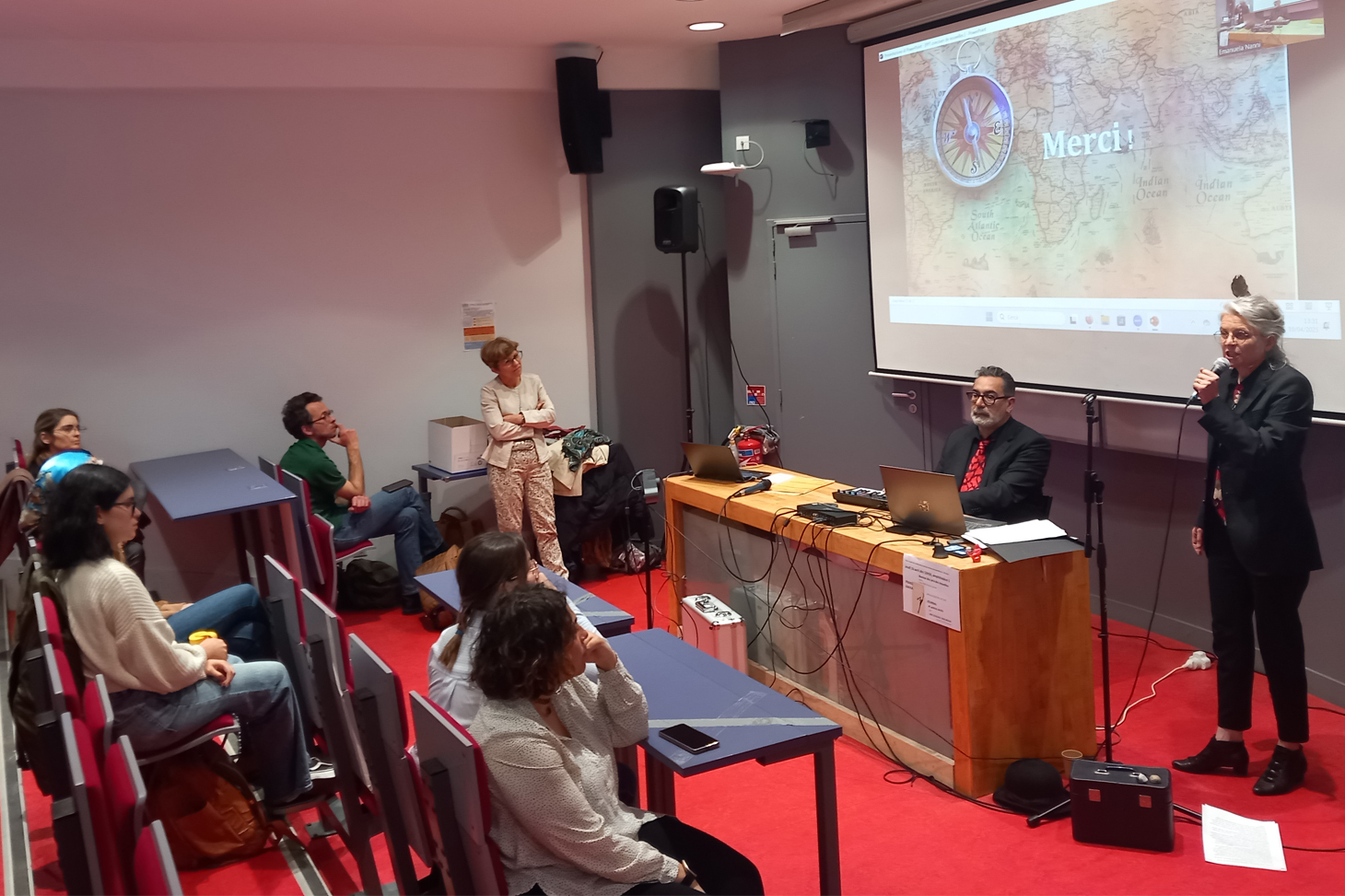
Discover Franz Kafka in a different way. With a musical reading in French and German of a selection of Franz Kafka's texts, Isabel Oed and Sergio Zamparo, who form the duo "Der Zoologe von Berlin" (Barbarins Fourchus company), invited their audience to rediscover the writing of the Prague author, whose work has been translated into (almost) every language in the world.
Their "Minimal-elektro-lecture" crowned the prize-giving ceremony for the short story competition on April 10, 2025, immersing students and teachers from the UFR SoCLE in the fascinating world of Kafka.
Isabel Oed and Sergio Zamparo, who form the duo "Der Zoologe von Berlin" (Barbarins Fourchus company), closed the prize-giving ceremony for the April 10, 2025 short story competition with their musical interpretations of short texts by Franz Kafka (from his diaries and other writings). The audience, made up of some 50 students from across the UFR SoCLE and around twenty teachers, was very enthusiastic.
The two Grenoble musicians' contribution was a perfect fit with the festive event, as the theme of the 2025 competition was "searching": a notion closely linked to Franz Kafka, who was himself constantly searching. The Prague author sought not only truth in the metaphysical sense, but also literary and aesthetic perfection, always choosing his words carefully and meticulously. A perfect example is his short story "Vor dem Gesetz" (Before the Law), or the request he made to his friend Max Brod: according to Kafka's last wishes, Brod should have burned his unpublished manuscripts.
Isabel Oed and Sergio Zamparo's artistic project, with its unique approach, introduced students to an innovative reading of traditional texts, a method akin to the research-creation we evoke every year in our courses devoted to current research. At the same time, the duo's concert enabled the students to step outside the perimeter of the courses given at the UFR SoCLE, notably through the setting in voice of Franz Kafka's writings, and to enrich their course through an encounter with the artistic world of the Grenoble conurbation. In this way, the public became aware of the productivity and vitality of literary works.
Share linkCopyCopyClose modal windowShare this page URLI recommend this page:Available at this address :The page will then be accessible from your "My favorites" menu.Stop videoPlay videoMute soundPlay soundChat: Got a question?Chatbot Robo FabricaMatomo visitor statisticsX (formerly Twitter)

 Societies, Cultures and Modern Languages