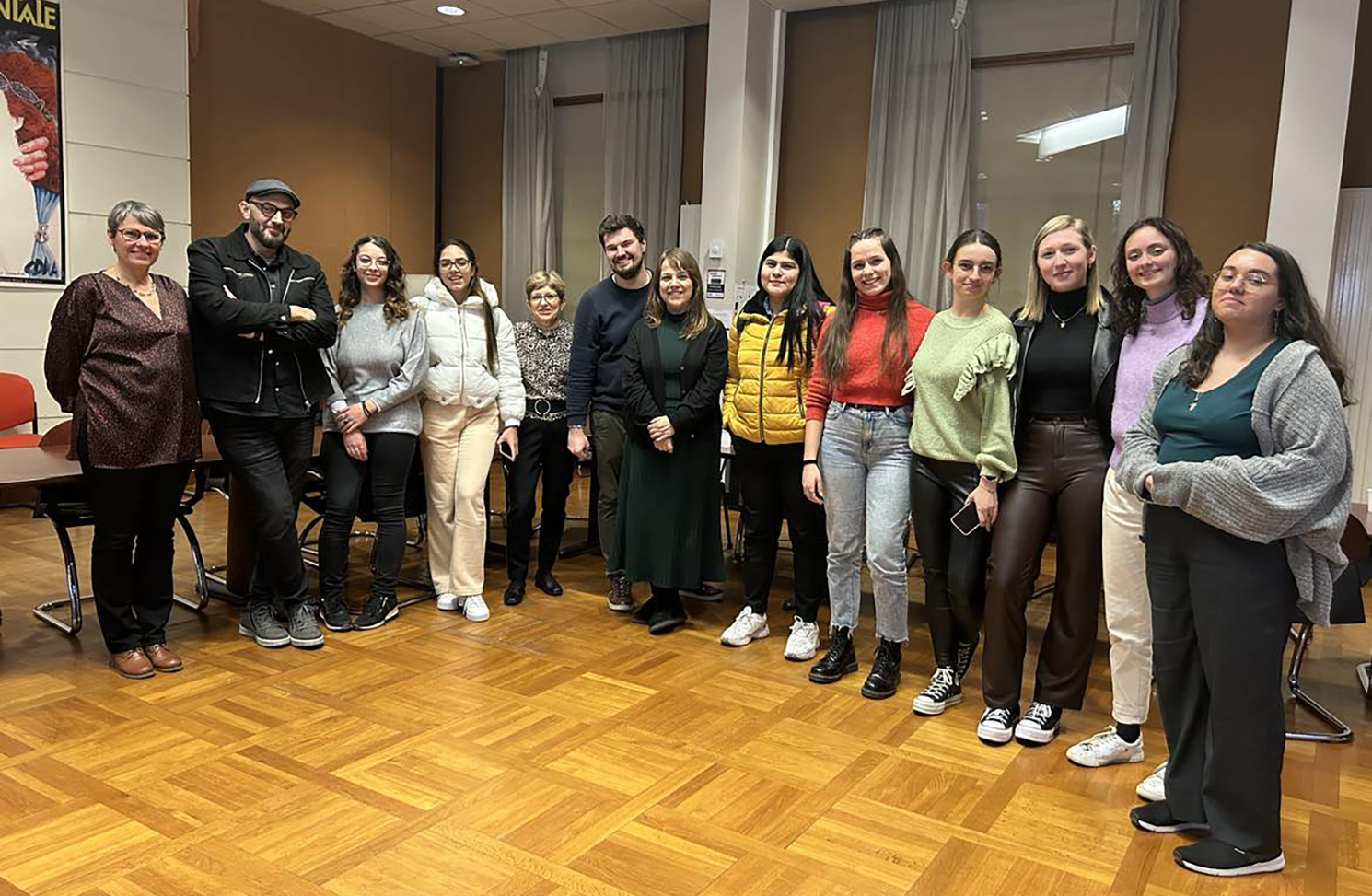
Laurence GARINO-ABEL and David CREMAUX BOUCHE have proposed an introduction to research for L3 LLCER Spanish students.
The project was born of a link between the course "Culture and Creation: Literature", dedicated to the memory and post-memory of the Spanish Civil War and Francoism in the arts (program 2022-23), led by David CREMAUX BOUCHE, and the course "Regards croisésproposed by Laurence GARINO-ABEL, dedicated to artistic expression in Spain in the 70s (program 2022-2023). The aim is to put students in a position to play an active role in their research, from the conception of the subject to its written and oral formalization, to prepare them for the two most popular Master's courses for students of the Licence LLCER, namely the Master MEEF and the Master LLCER.
The work was carried out in groups of two or three students. Each group had to choose its study theme, validated by their two teachers. Each week during the first semester, students were given a progress report on their work: problematization, choice of supporting documents, bibliographical references, writing standards, etc. A number of classes were also held jointly to cover methodological aspects and practice oral communication.
The project consists of two tasks:
The first is the creation of a written work compile a CAPES-type dossier (3 documents on a single theme) and write a twenty-page report on it (introduction, separate presentations of the documents, problematization of the dossier, analysis of the dossier based on the set problem).
The second task is a oral production. Each group had to make an oral presentation of its research work at the Young Hispanists Day (JJH) which was organized under the conditions of a university study day: group communication subject to a time constraint (20mn), organization in the form of round tables grouped by theme and led by moderators, time for exchanges. Students presented their work, then took the time to answer questions from UGA lecturers and external guests.
As an extension of this work, a study day was organized around and in the presence of Aroa Moreno Durán, Spanish poet and novelist, whose works were studied in David Crémaux-Bouche's "Culture et création : littératures" course. Students and teachers were able to discuss her two novels: La hija del comunista (2017) and La bajamar (2022), available from the UFR SoCLE Library. Miguel Ángel Hernández (novelist and art historian at the University of Murcia) also took part. Students were asked to preparing and moderating a round table to report on their reading of the author's novel. Thanks to the scientific papers presented by three of their teacher-researchers (David Crémaux-Bouche, Laurence Garino-Abel, Catherine Orsini-Saillet), the students were also able to take another approach to research, on a corpus they had studied themselves.
Student testimonials
Clémence BALANDREAU
This first project (JJH) enabled me to develop my research skills, to understand that I have thousands of resources, but that I have to choose the most relevant ones for my project, which in turn made me more efficient in my work. We all had to go over it several times before we found the right documents, the right problem and really succeeded in exploiting them to the full. Finally, this dossier enabled me to link documents, which will be a great help when creating future sequences that I'll have to carry out during the MEEF master's course and in my work as a secondary school teacher.
This second project (mesa redonda) enabled me to gain a finer understanding of a literary work, to extract key notions from it, and to learn how to ask precise, synthetic questions. The fact that I was able to moderate the round table gave me the confidence to deal with different people and stress, and to bounce back from each other's questions.
Isabela BERRIO RAMÍREZ
This pedagogical project, co-constructed as part of the Regards croisés and Culture et création courses over the course of a semester, gave me my first taste of what it's like to be a researcher in the Humanities. I learned the research methodology taught in class (consultation of documentary corpus, comparison of sources, analysis of documents placed in their context of creation, etc.) and I also put into practice my analytical and synthesis skills in the composition of my dossier, as well as my communication skills, since I had to present my dossier to an audience at the study day for young Hispanists, organized by Laurence GARINO-ABEL and David CRÉMAUX-BOUCHE. This work made me realize that this was a field I liked, in which I was doing well and in which I'd like to continue my higher education, so it was thanks to this experience that I chose the Master Recherche in Hispanic Studies, in order to become a Teacher-Researcher at a French university.
Anaïs CERCY
As part of the JJH, we had to work in pairs to put together a dossier on the theme of the recovery of republican memory in the arts. The completion of this project only strengthened my desire to do a Master LLCER in order to consolidate my knowledge of Hispanic literature and civilization.
During the year, we had the opportunity to talk to a young Spanish author, Aroa Moreno Durán, about her novel La hija del comunista. This meeting gave me a better understanding of the stylistic choices made by this writer to retrace the exile of Spaniards in East Germany under Franco's dictatorship.
Share linkCopyCopyClose modal windowShare this page URLI recommend this page:Available at this address :The page will then be accessible from your "My favorites" menu.Stop videoPlay videoMute soundPlay soundChat: Got a question?Chatbot Robo FabricaMatomo visitor statisticsX (formerly Twitter)

 Societies, Cultures and Modern Languages